
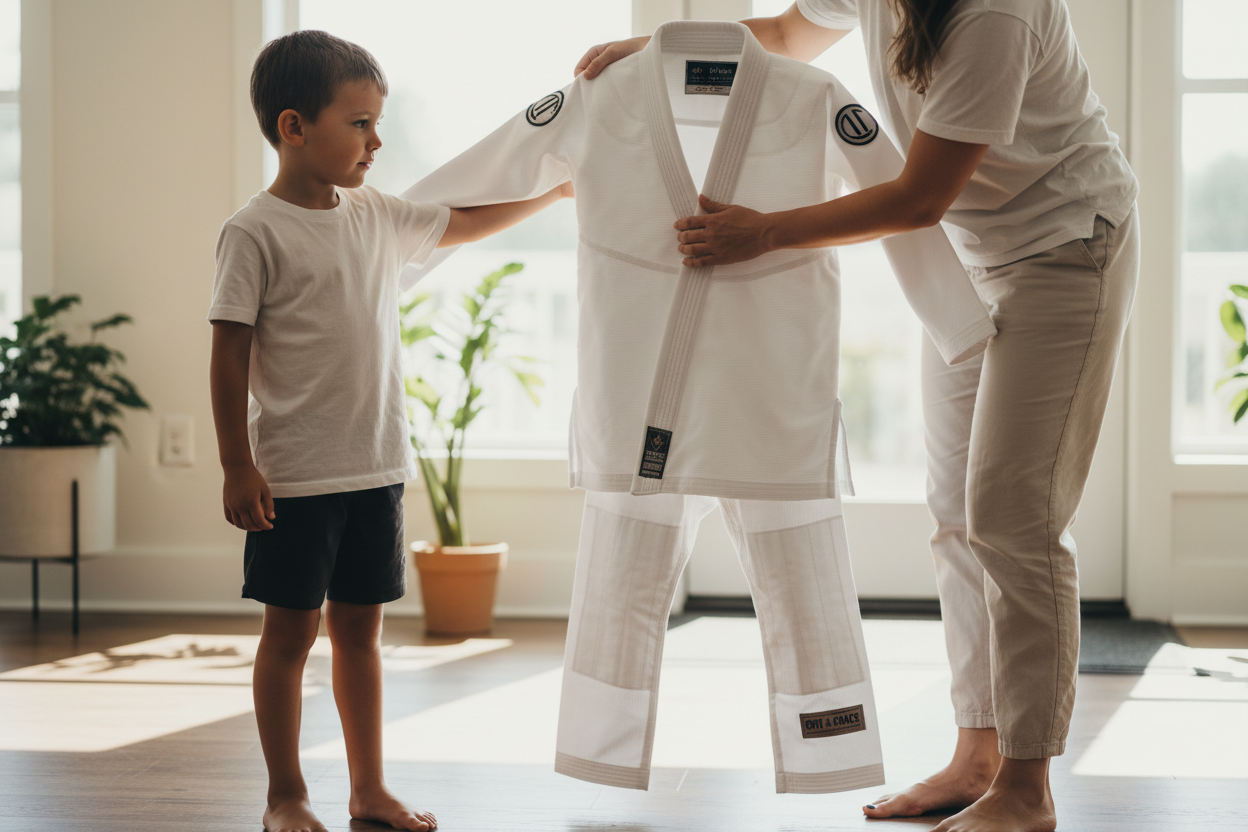
A poorly-fitted gi is one of the most common beginner mistakes — and it affects both performance and safety. Here's exactly how to measure your child for a perfect fit.
Why Fit Matters in BJJ
Unlike a loose TKD dobok, a BJJ gi needs to fit precisely. A gi that's too big gives opponents extra fabric to grip and control your child. A gi that's too small restricts movement and will tear faster. The right fit is snug but allows full range of motion in the shoulders, hips, and knees.
How to Measure
You'll need three measurements: height, weight, and arm span (fingertip to fingertip with arms extended). Most kids' gi sizing charts (including ours) are primarily based on height, with weight as a secondary guide. Never assume a gi size matches clothing size — BJJ sizing is entirely different.
Understanding Kids' Gi Sizes
Children's gi sizes typically run from C0 (smallest) through C4 or M0 (medium youth), then transition into adult sizes. As a general guide:
C2: approx. 3'6"–3'11" / 40–60 lbs
C3: approx. 4'0"–4'5" / 55–75 lbs
C4: approx. 4'4"–4'9" / 70–95 lbs
M0: approx. 4'8"–5'1" / 90–115 lbs
Always check the specific sizing chart on the product page — sizing can vary by brand and cut.
Our Recommendation for Beginners
The Jaguar Junior BJJ Gi ($69.99, available in white and blue) is our top pick for young beginners. It comes in sizes C2 through M0, runs true to size, and is made from a single-weave cotton blend that's lightweight enough for hot Florida gyms while being durable enough for daily training.
For kids moving into more competitive training, the Lancer BJJ Uniform ($65) offers a slightly heavier weave and a competition-ready cut.
One Size Up Rule
Kids grow fast. If your child is between sizes, size up. A slightly longer sleeve can be rolled; a gi that's too tight will need replacing in three months. Most parents find their child stays in a gi for a full season if they size up slightly.